
From Deir Yassin to Kol Ha’am: Shifting Media Narratives in the Arab-Israeli Conflict Newspapers, Media Bias and Power in the Cold War
By Sabrina McLennon
Edited by David Barsemian, Ghayas Osseiran, and Alexander Bagdade
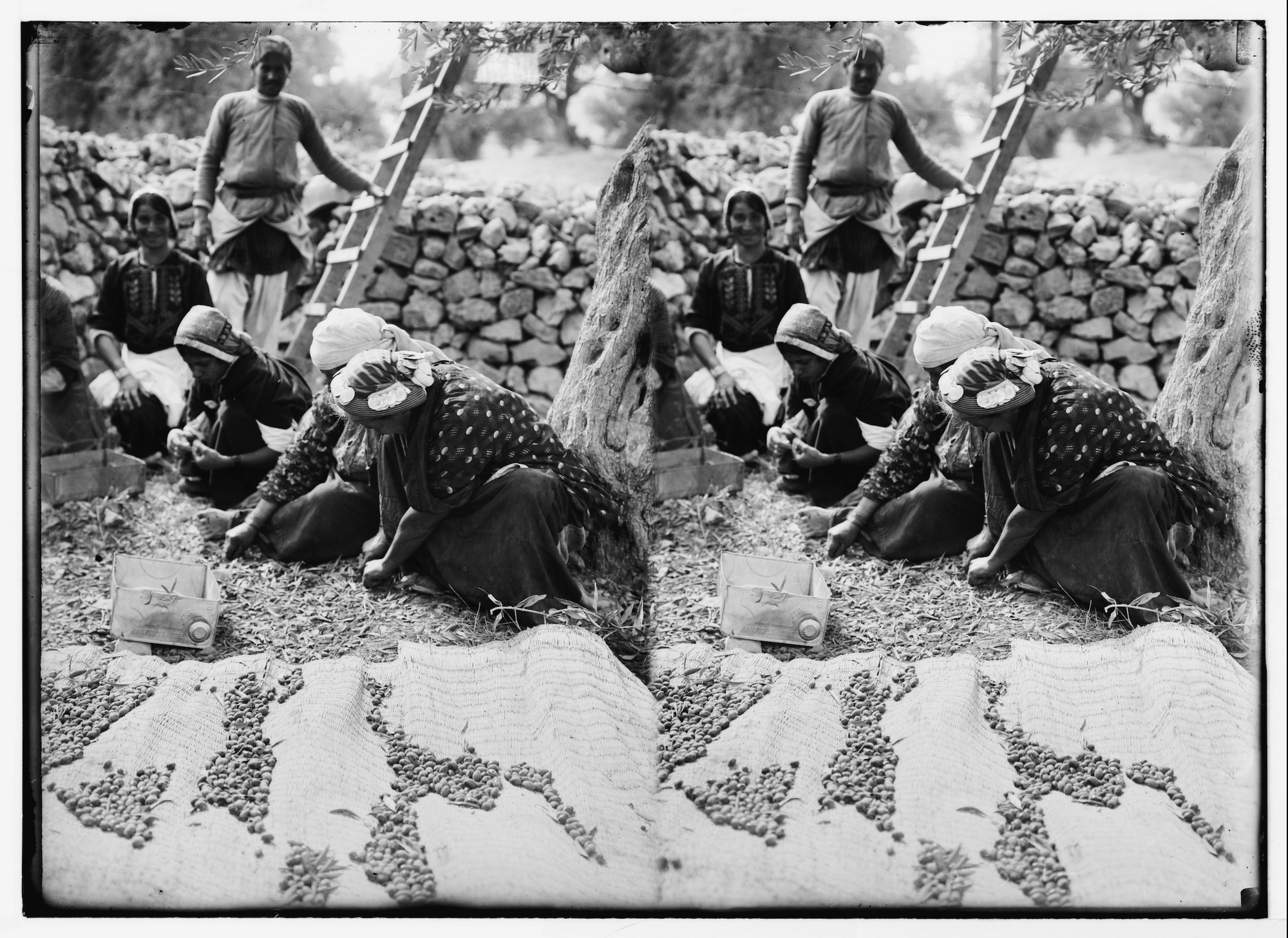
Beyond the cypress and olive trees of Mount Zion, the setting sun hides behind silver clouds and above warring factions, bathing Jerusalem anew in crimson-red, in a vain attempt to evade the panorama of bloodshed that has come to define the Arab-Israeli conflict. The genesis of the modern-day inter-communal antagonism plaguing historic Palaestina and Medinat Yisraʾel is traced to these antecedent events: the Balfour Declaration of 1917, the British conquest of Palestine, and the subsequent termination of the British Mandate of Palestine. Accordingly, the 1948 United Nations (UN) Partition Plan contributed to a collapse of law and order in the region, as the withdrawal of British authority, shaped by its legal doctrines and positivist framework, was characterized by the breakdown of centralized control in ‘Mandatory Palestine’. Under the false pretext of the lack of a governing body in Palestine, as well as the February 1948 Soviet-backed Czechoslovak coup d’état, and the risk posed by a ‘power vacuum’ in the Middle East, the United States secured its national interests by framing the region as part of a broader policy of Soviet containment, prioritizing continued access to oil, and recognizing the State of Israel in 1948, effectively succeeding Britain as the dominant power in the region. For our purposes, a study of the interplay between media power and the Arab-Israeli conflict, in the paradigms of the Cold War, will interrogate media as a locus of power, the space wherein power is decided, and public opinion is forged. Through a Cold War prism, American foreign policy interests influenced meta-narratives on the 1948 Deir Yassin massacre in the first Arab-Israeli war, and facilitated the construction of a democratic process in the Israeli press, as exemplified by the Israeli Communist Party's daily newspaper Kol Ha’am. Albeit the existence of over thirty Palestinian newspapers and periodicals between 1908 and 1914, print culture was heavily censored and constrained under the British Mandate for Palestine, limiting its political reach. By the détente period, however, the transnational influence of Third World revolutionary movements, particularly through the use of media, inspired by the Palestinian Liberation Organization (PLO) to publish multilingual guerrilla publications and internationalize the history and legacy of al-Nakba and Palestinian self-determination efforts and independence movement.
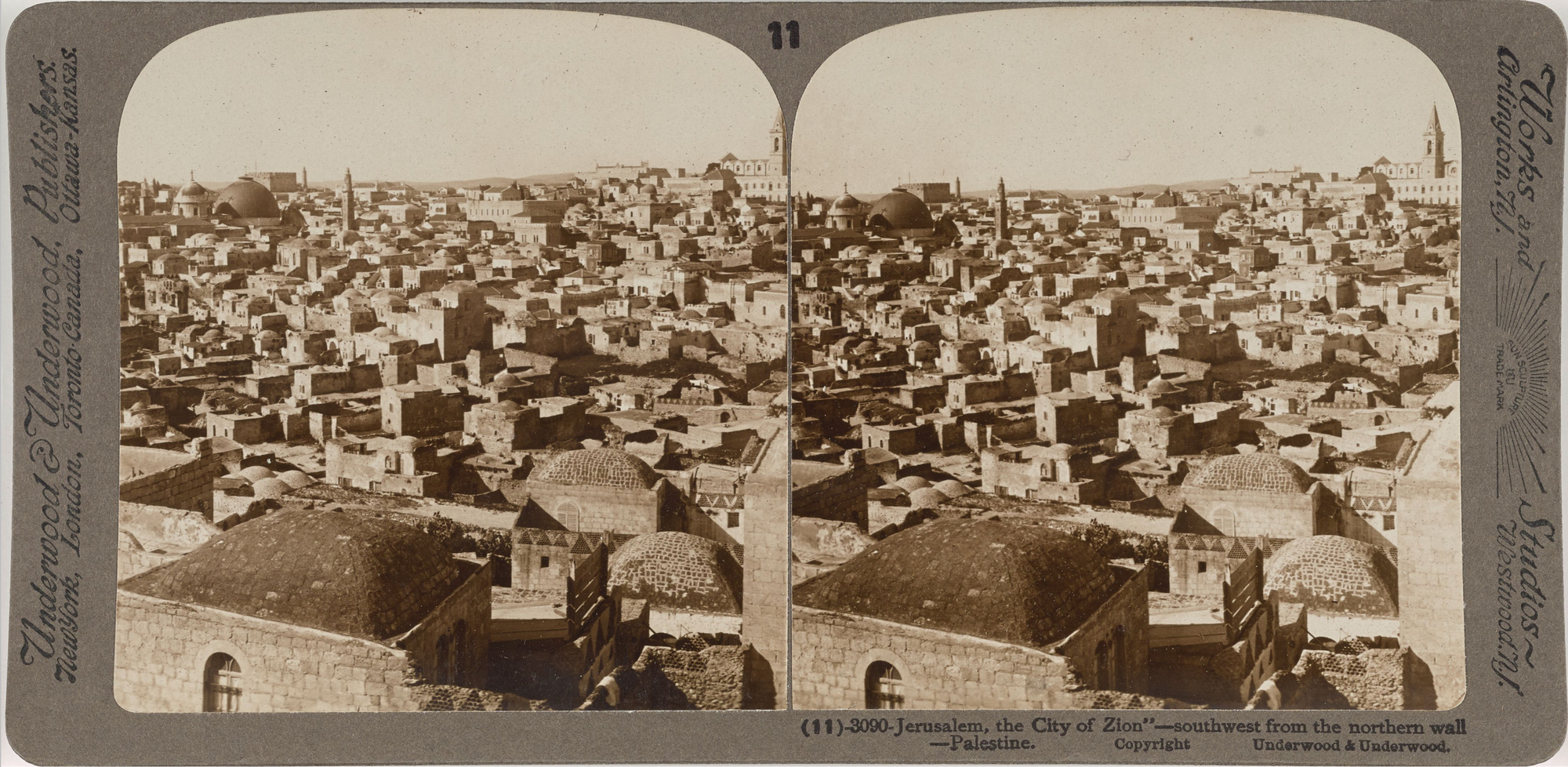
Within the complex tapestry of the early Cold War, the bias in American news coverage forged international views on the 1948 Deir Yassin massacre from the Israeli War of Independence. Albeit the Haganah and Irgun functioned as the primary military appendages of the pre-state Jewish Yishuv in Palestine, they represented a deep internal schism over the 1947 UN Partition Plan, with the latter group and Revisionist leaders rejecting the proposal in favour of a “Greater Israel” vision first articulated by David Ben-Gurion at the 1942 Biltmore Conference. Such ideological rigidity led to the wartime calamity of the Deir Yassin massacre on April 9, 1948, wherein at least 100 villagers were killed at the hands of this paramilitary group that sought a Jewish state encompassing the totality of Mandate Palestine. On the eve of Israeli statehood, May 15, 1948, the Irgun granted American correspondents information on the operation at Deir Yassin, a privilege otherwise denied to British counterparts; such strategic selectivity followed the 1946 King David Hotel bombing by the Irgun, which killed 91 people and fractured the Zionist relationship with Britain, explaining why the Jewish Agency, previously reliant on the 1922 mandate, shifted its diplomatic focus towards the U.S. for support.
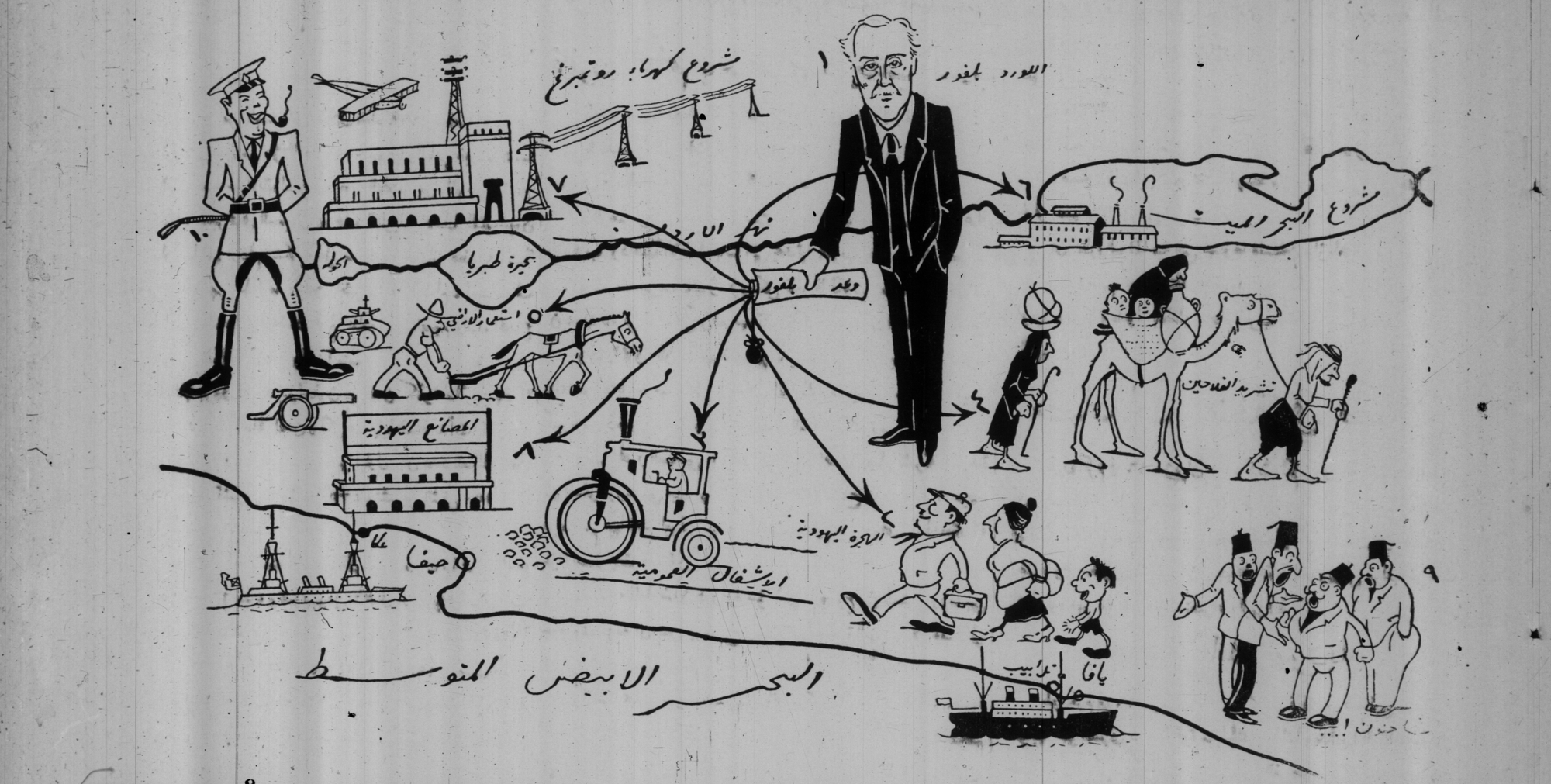
Subsequently, the U.S. correspondent Dana Adams Schmidt's headline featured the 10 April 1938 issue of the New York Times: ‘200 Arabs killed, Stronghold Taken; Irgun and Stern Groups Unite to Win Deir Yasin’. A reading of the end of the article, under the subhead ‘Victors Describe Battle' reads: “The Irgunists and Sternists escorted a party of United States correspondents to a house in Givat Shaul, near Deir Yasin [sic], tonight and offered them tea and cookies and amplified details of the operation.” Although on the full terms of the Irgun, the decision of the Jewish paramilitary to entrust the story to American correspondents foreshadows the eventual alliance shared between Washington and Israel. Moreover, Schmidt’s matter-of-fact narrative throughout the report is framed amidst President Truman’s remarks, in response to Secretary of State George Marshall, and large coalitions of American policymakers, “I am sorry gentlemen, but I have to answer to hundreds of thousands who are anxious for the success of Zionism. I do not have hundreds of thousands of Arabs among my constituents.” Truman’s remarks at the American Society of Newspaper Editors stated that it was the patriotic duty of the press to support the President’s initiatives and ensure ‘the American people’ were behind U.S. foreign policy to hence safeguard ‘the welfare of the world’. As such, Schmidt’s account exemplifies the nexus of power and American media bias in the Arab-Israeli conflict. Effectively, by restricting access to solely U.S. correspondents, the Irgun report on Deir Yassin was used to center the narrative of its perpetrators. Inversely, Schmidt’s bold headline ’200 Arabs Killed’ introduced the Arab-Israeli conflict to the American public yet maintained political indifference to the bloodshed of Arabs, thus in line with U.S. foreign policy.

Furthermore, the media pluralism of the Israeli press, in concurrence with Israeli law, embodied the bastion of free thought, speech, and ‘pro-democratic’ values of Judeo-Christian civilization, hence aligning with U.S. interests in the Cold War. After the horrors of the 1948 Arab-Israeli War, some 600,000 to 760,000 Palestinians retreated from areas of the homeland under Jewish authority. Thereafter, the establishment of a modern Jewish State in biblical Eretz-Israel was declared on 14 May 1948 by the de facto leader of Palestine’s Jews, David Ben-Gurion. Pre-dating the birth of Eretz-Israel by more than half a century, Hebrew newspapers existed as the mouthpiece for an assortment of political parties and constituted an integral part of Jewish revival in the land. In the pre-independence period, party newspapers were expected to help advance national goals, as defined by the politician-military elite. In the increasingly bipolar landscape of the 1950s, the Mapai – Israel’s left-leaning government – maintained a policy of neutrality with respect to the Cold War conflict between the United States and the Soviet Union. Despite beginning to seek American support, they were not yet willing to openly declare allegiance to American leadership as to ensure the young nation-state’s independence, emphasizing national interest and “non-identification”. Thus, the January 1953 editorial of the Israeli Communist Party's daily Kol Ha’am (The Voice of the People) and its Arabic-language sister Al-Ittihad sent shock waves throughout the region by alleging that Israel had offered to send 200,000 troops to support the American war effort in North Korea, therefore ending neutrality. Kol Ha’am offered additional criticism: “[A]ll forms of surrender by the Ben Gurion Government, and all her demonstrations of faithfulness, will not avail her with her American masters.” In actuality, apart from its vitriolic language and exaggerated rhetoric, the article accurately described the shift in Prime Minister Ben-Gurion’s stance from neutrality in foreign affairs to military support for the United States in the event of war in the Middle East.
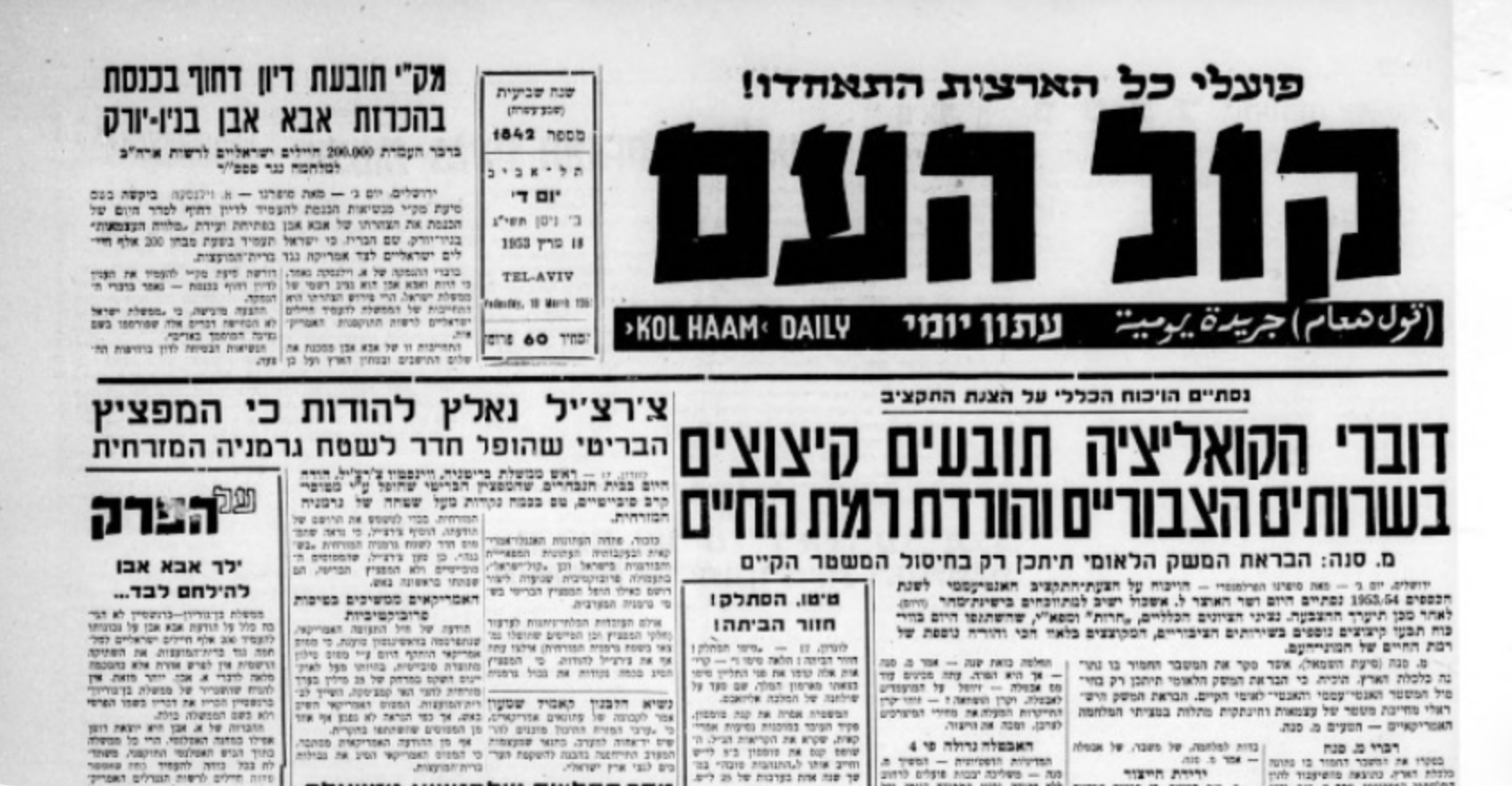
In response, the General Minister of the Interior suspended the communist newspaper; an order thereafter reversed by Kol Ha’am’s petition to the Israeli Supreme Court in 1953, and their ensuing decision. Located in the Zionist democratic principles of the Israeli Declaration of Independence and the importation of an American judicial structure, the seminal case of Kol Ha’am v. The Minister of Interior, under the counsel of Israeli-American Justice Simon Agranat, established freedom of expression via judicial legislation, and thus set a precedent for civil rights decisions in Israel. As such, the divorce of the region’s legal system from British colonial authoritarianism to projection of democratic liberalism constituted the genesis of Israel’s democratic process. To note, at this period, the fallacy of McCarthyism ensnared the United States in a spiral of state-sanctioned persecution of left-wing individuals. In addition, a year prior, President Truman formalized the federal employee loyalty program to safeguard the government against suspected federal employees. Notwithstanding the ‘special relationship’ to yet be concretized, the political agency of the nascent state of Israel is underscored by the Israeli government’s allowance of the communist party press to continue following Moscow’s line, and the Communist Party press broadcast its unbound criticism of ‘Zionism’ as an illegitimate liberation movement. In the framework of a bipolar hegemony, the role of national ethos, as an adjunct to state politics, is seen through the region’s bilateral legal landscape and periodical press.
An antecedent to the First Arab-Israeli War, the flight and expulsion of the predominant Arab populace by the nascent state of Israel, since known as al-Nakba, in juxtaposition with the number of Palestinian refugees sent to Arab states, stirred Arab nationalist sentiment and hostilities towards Israel. In effect, during the 1940s to 1950s, the secular Arab Nationalist Movement, under Egyptian President Gamal Abdel Nasser’s pan-Arab rhetoric, weaponized the Palestinian calamity and the expansion of Jewish settlements as a perennial reminder of the humiliation and dispossession of 1948. Under the thumb of the Egyptian government, the Palestinian Liberation Organization (PLO) comprised a melée of fragmented nationalist groups: the Fatah, the Democratic Front for the Liberation of Palestine (DFLP), and the Popular Front for the Liberation of Palestine (PFLP). With the defeat of Egyptian forces during the Third Arab-Israeli War, in February 1969, guerrilla control of the organization was established with Yassir Arafat’s ascension to Chairman of the Palestine Liberation Organization (PLO). Under his leadership, the PLO employed guerrilla warfare tactics to reclaim the whole of Mandate-era Palestine until December 1988. Hence, the PLO drew inspiration from the revolutionary strategies and ideologies of other Third World movements, in an attempt to distance itself from Arab nationalism and bring international prominence to the Palestinian cause.
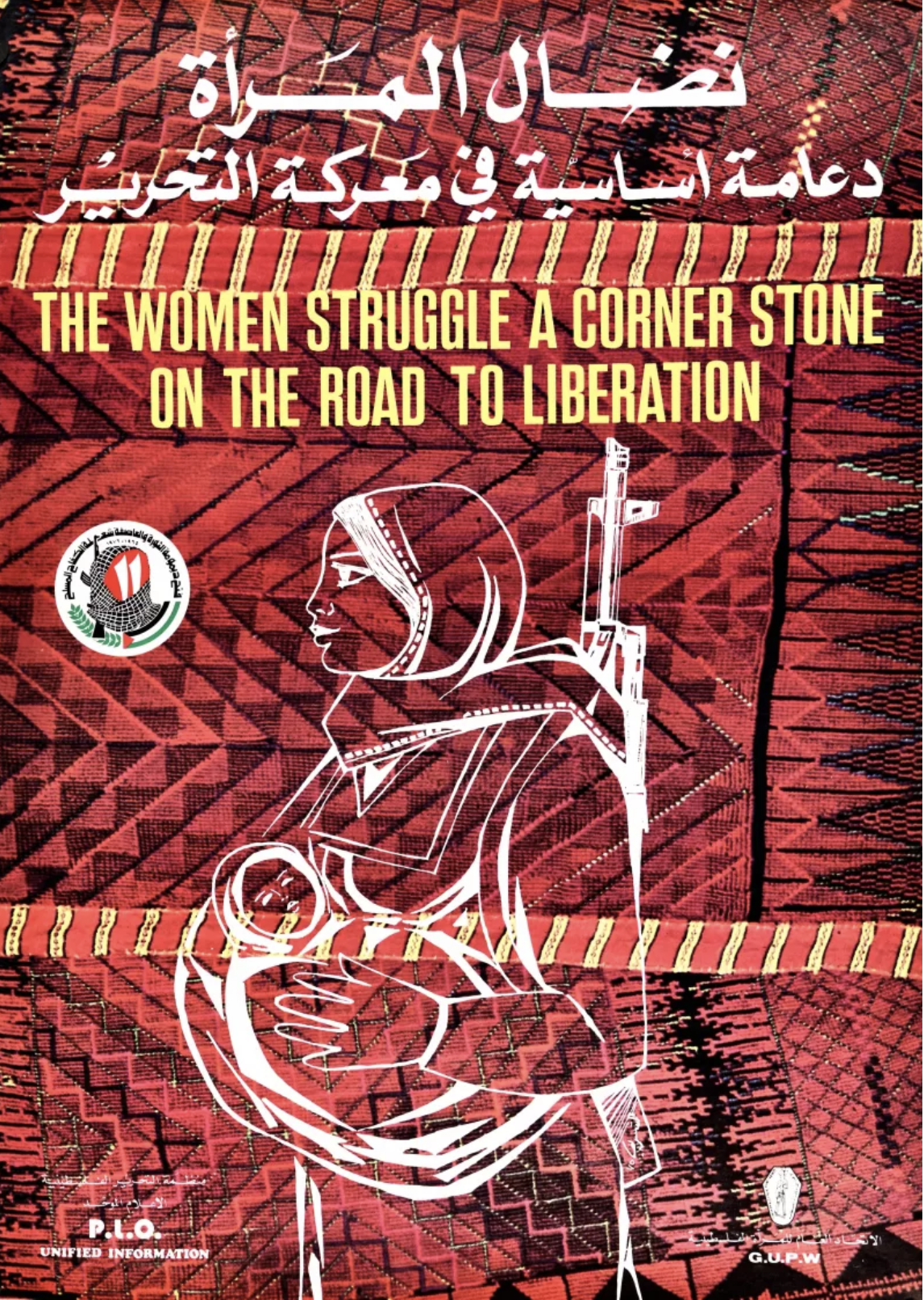
Notably, in August 1967, the PLO began publishing articles under the series Revolutionary Studies and Experiences that outlined the core policy of the Fedayeen resistance movement, with the materials appearing in Arabic, English, and French alike. In effect, the series featured the communist regimes in North Korea and China, with three pamphlets devoted to the Vietnamese, Chinese, and Cuban revolutions. More broadly, fedayeen newspapers covered revolutionary struggles abroad and followed international reactions to Palestinian resistance. For instance, in 1968, Filastine al-Thawra ran a regular section, “Reports of the Revolution in the Last Half Month,” to share news of armed struggles in Southeast Asia, Latin America, and Africa. Likewise, the 1969 Al-Fatah pamphlet The Palestinian Freedom Fighters and the World Press re-emphasizes the critical importance of international media, by citing British and American news sources such as the Guardian, Life magazine, the Daily Star, and the International Herald Tribune, and their parallels between the Palestinian Liberation Movement, the South Vietnamese National Liberation Front, and the European resistance movements of World War II. Thus, by 1969, the PLO guerrilla pamphlets had succeeded in presenting the Palestinian people, carrying out armed resistance, as no different from the ordinary subjugated people of Vietnam, Angola, South Africa, Bolivia or elsewhere, also interested in the eventual liberation of their homeland and the self-determination to which all peoples are entitled. In the volatile political landscape of the Cold War, guerrilla newspapers comprised a strategy of revolution premised upon forging ties with the international community, despite Washington’s refusal to arrange a negotiated settlement to the Arab-Israeli conflict from 1969–1988. In effect, through multilingual guerrilla pamphlets, the PLO successfully divorced the Palestinian plight from Arab nationalism and established its revolutionary image by tapping into the Third-World transnational revolutionary network.

In conclusion, the Arab-Israeli Conflict, as a proxy theatre of the superpower rivalry, exemplified the nexus between mass media and political power in a volatile political landscape. Within the paradigms of the Cold War, the significance of meta-narratives and American news print media’s narration of the First Arab-Israeli War is observed through the conflict’s legacy. In addition, the development of a legal democratic process in Israel, resulting from the seminal case of Kol Ha’am v. The Minister of Interior and the importation of American legislation, exemplified the interplay between national ethos and state politics in determining government policy on civilian rights and freedom of expression. In the same milieu, the transnational influence of Third World revolutionary movements facilitated global news discourse on the Palestinian Liberation Movement through the publication of guerrilla booklets by the PLO. In a bipolar system context, the unstitching of the collective memory woven by the 1948 Arab-Israeli War is accomplished through a macrocosmic consideration of the afflicted region’s colonial and imperial legacy. Thus, in the global sphere of revolutionary action and U.S.-Soviet rivalry, paired with the colonial history of the Middle East, a deeper consideration of the role of media and nation-states in shaping public perception of the Arab-Israeli conflict is required to unearth the sequentiality of acts responsible for the unremitting bloodshed in the ancient lands of Canaan.
Bibliography
Ben-Eliezer, Uri. ‘A Nation-in-Arms: State, Nation, and Militarism in Israel’s First Years’. Comparative Studies in Society and History 37, no. 2 (April 1995): 264–85. https://doi.org/10.1017/S0010417500019666.
Bickerton, Ian J. ‘President Truman’s Recognition of Israel’. American Jewish Historical Quarterly 58, no. 2 (1968): 173–240. https://www.jstor.org/stable/23875906.
Bracka, Jeremie M. ‘“From Banning Nakba to Bridging Narratives”: The Collective Memory of 1948 and Transitional Justice for Israelis and Palestinians’. In Law and Memory, edited by Uladzislau Belavusau and Aleksandra Gliszczyńska-Grabias, 1st ed., 348–73. Cambridge University Press, 2017. https://doi.org/10.1017/9781316986172.018.
Chamberlin, Paul Thomas. The Global Offensive: The United States, the Palestine Liberation Organization, and the Making of the Post-Cold War Order. Oxford University Press, 2012.
Dietrich, Christopher R. W., editor. A Companion to U.S. Foreign Relations: Colonial Era to the Present. John Wiley & Sons, 2020.
Edrey, Yoseph M. ‘The Israeli Constitutional Revolution/Evolution, Models of Constitutions, and a Lesson from Mistakes and Achievements’. The American Journal of Comparative Law 53, no. 1 (2005): 77–123. https://www.jstor.org/stable/30038688.
Evensen, Bruce J. ‘The Limits of Presidential Leadership: Truman at War with Zionists, the Press, Public Opinion and His Own State Department over Palestine’. Presidential Studies Quarterly 23, no. 2 (1993): 269–87. https://www.jstor.org/stable/27532278.
‘Freedom Archives Search Engine’. Accessed 30 November 2023. https://search.freedomarchives.org/search.php?view_collection=24&keyword%5B%5D=United+Nations+%28UN%29.
Gilboa, Eytan. ‘The Media Campaign in the 2003 Israeli Elections’. Israel Affairs 10, no. 4 (December 2004): 217–41. https://doi.org/10.1080/1353712042000283757.
Global Freedom of Expression. ‘Kol Ha’am v. Minister of Interior’. Accessed 29 November 2023. https://globalfreedomofexpression.columbia.edu/cases/israel-kolhaam/.
Gold, Dore. ‘The Historical Significance of the Balfour Declaration’. Jewish Political Studies Review 28, no. 1/2 (2017): 8–13. https://www.jstor.org/stable/44510469.
Gross, Aeyal M. ‘The Politics of Rights in Israeli Constitutional Law’. Israel Studies 3, no. 2 (1998): 80–118. https://www.jstor.org/stable/30245715.
Haron, Miriam. ‘Britain and Israel, 1948-1950’. Modern Judaism 3, no. 2 (1983): 217–23. https://www.jstor.org/stable/1396081.
Hogan, Matthew. ‘The 1948 Massacre at Deir Yassin Revisited’. The Historian 63, no. 2 (2001): 309–33. https://www.jstor.org/stable/24450239.
Jacobson, David M. ‘Palestine and Israel’. Bulletin of the American Schools of Oriental Research, no. 313 (1999): 65–74. https://doi.org/10.2307/1357617.
Joseph, Teresa. ‘Mediating War and Peace: Mass Media and International Conflict’. India Quarterly 70, no. 3 (2014): 225–40. https://www.jstor.org/stable/45072817.
Khalidi, Rashid. The Hundred Years’ War on Palestine: A History of Settler Colonialism and Resistance, 1917-2017. 1st ed. Metropolitan Books, Henry Holt and Company, 2020.
“Kol Ha’am v. Minister of Interior.” Global Freedom of Expression, https://globalfreedomofexpression.columbia.edu/cases/israel-kolhaam/. Accessed 27 Nov. 2023.
Lahav, Pnina. ‘American Influence on Israeli Law: Freedom of Expression’. Israel and the United States: Six Decades of US-Israeli Relations, 6 March 2012, 187. https://scholarship.law.bu.edu/faculty_scholarship/202.
Lewis, Bernard. ‘Palestine: On the History and Geography of a Name’. The International History Review 2, no. 1 (1980): 1–12. https://www.jstor.org/stable/40105058.
Lutz, James M, and Georgia Wralstad Ulmschneider. ‘Civil Liberties, National Security and U.S. Courts in Times of Terrorism’. Perspectives on Terrorism 13, no. 6 (2019): 43–57. https://www.jstor.org/stable/26853740.
Nisan, Mordechai. ‘The PLO and Vietnam: National Liberation Models for Palestinian Struggle’. Small Wars & Insurgencies 4, no. 2 (1993): 181–210.
Pappé, Ilan. The Idea of Israel: A History of Power and Knowledge. Essential Palestine/Israel Series. Verso, 2025.
Ravndal, Ellen Jenny. ‘Exit Britain: British Withdrawal From the Palestine Mandate in the Early Cold War, 1947–1948’. Diplomacy & Statecraft 21, no. 3 (14 September 2010): 416–33. https://doi.org/10.1080/09592296.2010.508409.
‘Remarks at a Meeting With the American Society of Newspaper Editors | Harry S. Truman’. Accessed 29 November 2023.
Rodgers, James. ‘Journalism, Separation and Independence: Newspaper Coverage of the End of the British Mandate for Palestine, 1948’. Journalism 20, no. 11 (November 2019): 1497–1512. https://doi.org/10.1177/1464884917703468.
Rubin, Barry M. The Middle East: A Guide to Politics, Economics, Society, and Culture. London ; New York: Routledge, 2015.
Sanz Sabido, Ruth. The Israeli-Palestinian Conflict in the British Press. Palgrave Macmillan UK, 2019. DOI.org (Crossref), https://doi.org/10.1057/978-1-137-52646-5.
Shlaim, Avi. “The Debate about 1948.” International Journal of Middle East Studies, vol. 27, no. 3, Aug. 1995, pp. 287–304. DOI.org (Crossref), https://doi.org/10.1017/S0020743800062097.
Stock, Ernest. “The Press of Israel: Its Growth in Freedom.” Journalism Quarterly, vol. 31, no. 4, Dec. 1954, pp. 481–90. DOI.org (Crossref), https://doi.org/10.1177/107769905403100408.
Sinanoglou, Penny. ‘British Plans for the Partition of Palestine, 1929-1938’. The Historical Journal 52, no. 1 (2009): 131–52. https://www.jstor.org/stable/40264161.
The New York Times. ‘200 ARABS KILLED, STRONGHOLD TAKEN; Irgun and Stern Groups Unite to Win Deir Yasin -- Kastel Is Recaptured by Haganah’. Accessed 29 November 2023. http://timesmachine.nytimes.comhttp://timesmachine.content-tagging.us-east-1-01.prd.dvsp.nyt.net/timesmachine/1948/04/10/106929312.html?pageNumber=6.
‘Truman’s Loyalty Program | Harry S. Truman’. Accessed 29 November 2023. https://www.trumanlibrary.gov/education/presidential-inquiries/trumans-loyalty-program.
Tusalem, Rollin F. ‘The Colonial Foundations of State Fragility and Failure’. Polity 48, no. 4 (2016): 445–95. https://www.jstor.org/stable/26358277.
Thompson, Gardner. Legacy of Empire: Britain’s Support of Zionism and the Creation of Israel. Saqi Books, 2022.