
The War Began Without Him: Imperial Circumvention and The Procedural Engineering of Russia’s General Mobilization Order during the 1914 July Crisis
by Miranda Blell
INTRODUCTION
On the afternoon of July 30, 1914, Nicholas II issued the General Mobilization Order (GMO), effectively committing the Russian Empire to a war against Austria-Hungary and Germany. The decision was not linear; in the preceding twenty-four hours, Nicholas II had approved, rescinded, and then reinstated the order. This hesitation comports with historians' characterization of the Tsar as Russia's "peace-loving" master. Yet Nicholas II's eventual sanctioning of the GMO represented a divigation between his alleged commitment to a settlement and the mobilization that occurred under his authority. This dissonance is best understood when situated within assessments of his character, wherein he was described as "weak and excessively kindhearted." Indeed, McKinney (2018) observes that "the Tsar's resolve against the counsel offered by his hawkish advisors was weak." Clark (2012) advances this characterisation by identifying a contradiction within Nicholas II's disposition: "an ingrained aversion to conflict" conjoined with "exceptional pliancy in the face of external pressures." Considered together, these assessments portray a sovereign whose autonomy—and, by extension, authority—was susceptible to the exigencies of his advisors. By concentrating trust in his cabinet—principally War Minister Sukhomlinov, Chief of the General Staff Yanushkevich, and Foreign Minister Sazonov—the Tsar institutionalized an informational environment that favored the military establishment. This instability was compounded by the effects of the 1905 Revolution, which diminished the Tsar's authority through concessions that redistributed power to ministerial departments. The resulting configuration produced a quasi-fragmented autocracy in which discrete centres of influence operated with autonomy, thereby producing a state in which "the waxing of one node in the system produced the waning of others." Taken together, these conditions rendered the Tsar's sovereignty contingent upon the prerogatives of his advisors, who circumvented and, at times, outright subverted his executive oversight.
The issuance of the GMO was the outcome of a process in which procedural sequencing allowed the Tsar's cabinet to pre-emptively structure—and thereby pre-determine—executive assent. Drawing on diplomatic correspondence, autobiographical accounts, and contemporary testimony, this study reconstructs the mechanisms through which these officials constrained the sovereign's policy options. It contends that the GMO represented the culmination of a sequence in which Russian policymakers—through informational control, procedural orchestration, and the manipulation of perceived constraints—compelled Nicholas II's consent.
THE JULY CRISIS OF 1914 | A CHRONOLOGY
Upon being informed of Austria-Hungary's ultimatum to Serbia on July 24, Sazonov exclaimed: "It's a European war!" His reaction accorded with the dominant interpretation among Russian officials, who regarded the démarche as the precursor to a continental war; this perception situated the subsequent deliberations within a framework that assumed the imminence of a Europe-wide conflagration, rather than a conflict localized to the Balkans. With minimal effort expended toward securing a settlement, this perception was advanced as the only practicable course of action. That same day, the Council of Ministers authorized the War Preparation Period. Outlined in 1913 by Sukhomlinov, this phase was defined as "the period of diplomatic complications preceding the commencement of hostilities, during which all departments are required to undertake preparatory measures essential for the security and efficacy of mobilizing the army, navy, and fortresses, [and] for the deployment of forces to the threatened frontier." According to Fay (1921), the War Ministry's "Survey I" and "Survey II" regulations were authorized by the General Staff. "Survey I" permitted the call-up of reservists to complete the peacetime establishment of active units and to replace men recently discharged, thereby bringing regiments to wartime strength. These preparations were exemplified by the accelerated promotion of officers stationed at the Tsar's residence in Krasnoe Selo, as well as by the redeployment of the 2nd and 3rd Independent Cavalry Brigades to positions deemed advantageous. Moreover, General Danilov's orders stipulated the deferment of the Kazan 5th Cavalry Division's transfer to Poland, thereby preserving its readiness for operations against Germany. In parallel, "Survey II" vested Sukhomlinov with the authority to summon additional classes of reservists for training, even when such measures exceeded the appropriations fixed by the military budget. The concurrent activation of both surveys effectively constituted a Partial Mobilization Order (PMO), while preserving the legal fiction that mobilization had not yet been formally proclaimed. According to Kennedy (2014), these measures were in agreement with the Tsar's wishes.
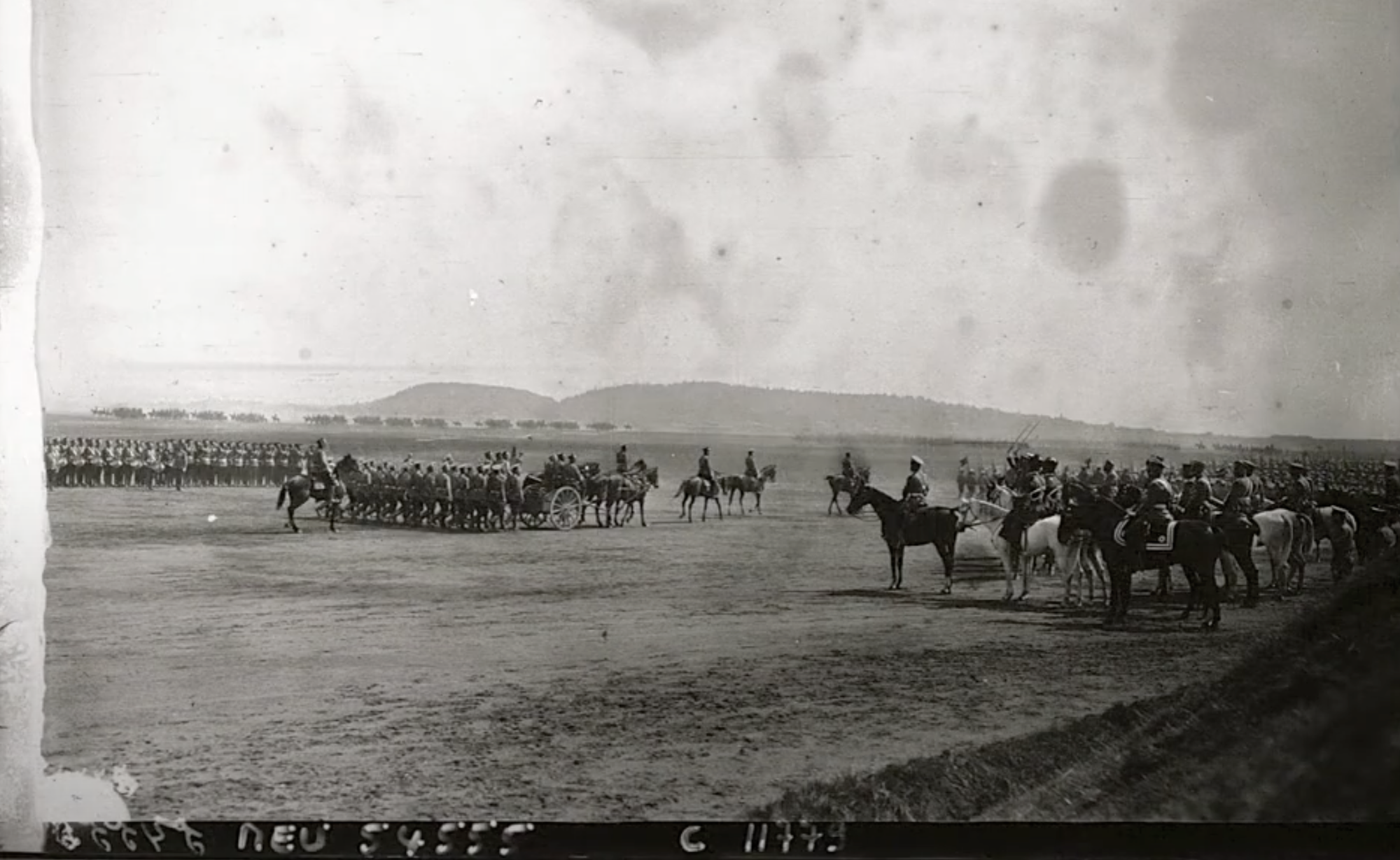
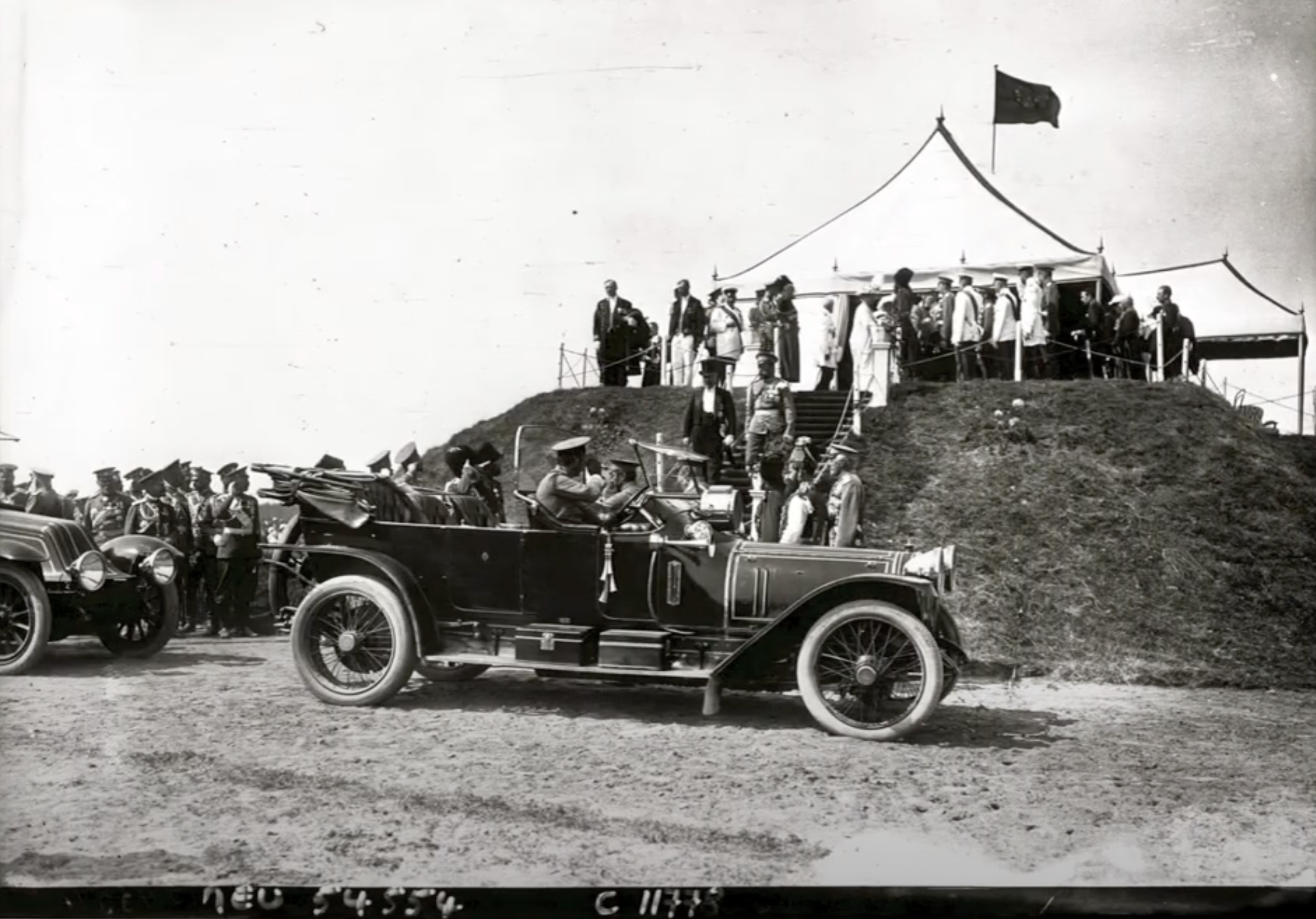
On July 26, the War Preparation Period was instituted in the military districts of Kiev, Odessa, Moscow, and Kazan, while the municipal governments of St. Petersburg and Moscow declared a state of siege. Diplomatic correspondence from July 25 sought to minimize the significance of these measures, reporting that "His Majesty has decided in principle to mobilize the thirteen army corps ultimately earmarked for operations against Austria-Hungary," which had been framed as contingent upon an attack on Serbia. However, Florinsky (1927) stated that the operational constraints inherent in a PMO rendered its discontinuation impracticable, thereby necessitating a transition to a GMO under most conditions. Indeed, contemporary assessments corroborate this interpretation. Discussing the PMO, the French ambassador in St. Petersburg, Paléologue, concurred with his Russian counterpart, Izvolsky, that "It's war this time." The importance of the PMO's preemptive measures is evidenced in Nicholas II's telegram on July 30, wherein the Tsar acknowledged that "The military measures which have now come into force were decided five days ago." This admission is significant for two reasons. First, it locates the inflection point of 'no return' as occurring not with the Tsar's assent to a GMO, but with the antecedent, extra-imperial initiation of the Period Preparatory to War. This substantiates the contention that the institutional mechanisms of Russian mobilization had been operationalized before—and autonomous from—the Tsar's assent. Second, it underscores Yanushkevich's agency in exploiting the distinction between "preparation" and "mobilization" to advance Russia's war effort under the guise of administrative routine. This enabled Yanushkevich to initiate measures functionally indistinguishable from a GMO, thereby pre-empting Nicholas II’s ability to veto it, as discussed in a later section.
During this time, Nicholas II attempted to avert a continental war. On July 27, the Tsar proposed a mediation effort, suggesting that Austria-Hungary's conflict with Serbia be adjudicated by the Hague Tribunal after a consultation with France, Britain, Germany, and Italy. In a telegram to Sazonov, the Tsar urged immediate action: "Perhaps there is yet time before events happen which cannot be undone. To gain time, try to take this step today." However, Wegerer (1928) observes that Sazonov ignored the Tsar's injunction to seek Franco-British engagement or to initiate arbitral proceedings.
On 28 July, Yanushkevich participated in a conference with Generals Danilov, Dobrorolsky, and Ronzhin, all of whom reaffirmed the necessity of instituting a GMO. Acting upon this consensus, he prepared two separate edicts for the Tsar: one authorizing a GMO, and the other codifying the provisions of the PMO. According to Kennedy, this deviated from the policy agreed upon by Sazonov and Yanushkevich on 24 July, and from the preferences that, as previously stated, had been expressed by the Tsar himself. Turner (1968) argues that, although such a policy was practicable had the General Staff chosen to pursue it, Sazonov's confidence in its diplomatic innocuousness was ill-founded. Under the stipulations of the Schlieffen Plan, just the PMO would have compelled Germany to pursue mobilization. On July 27, the German Foreign Secretary, Jagow, stated that "if Russia only mobilized in the south, Germany would not mobilize; but if she mobilized in the north, Germany would have to do so." Nonetheless, on July 28, Sazonov and Yanushkevich issued divergent communications regarding their intentions to proceed with mobilization. According to Turner, Sazonov—likely with the Tsar's support—dispatched a telegram to Berlin, with copies to Vienna, Paris, London, and Rome, declaring: "In consequence of the Austrian declaration of war on Serbia, we shall tomorrow proclaim mobilization... Inform the German Government of this and lay stress on the absence of any intention on the part of Russia to attack Germany." By contrast, later that night, Yanushkevich dispatched an antithetical directive to the commanding officers of all military districts, issued even before the formal ratification of any plan: "July 30 will be proclaimed the first day of our general mobilization. The proclamation will be followed by the regulation telegram." This latter instruction, which presupposed a definitive course of action, suggests a degree of operational foresight at odds with the Tsar's disposition. Nicholas II’s discomfort with the policy adopted by his staff is discernible in a telegram to Kaiser Wilhelm II, in which he conceded his political impotence:
"I foresee that soon I shall be overwhelmed by the pressure forced upon me[,] and be forced to take extreme measures which will lead to war. To try and avoid such a calamity as a European war, I beg you in the name of our old friendship to do what you can to stop your allies from going too far."
Throughout July 29, Sazonov persisted in his circuit of diplomatic consultations. To the German Ambassador, Pourtalès, he reiterated similar assurances. Sazonov tempered such rhetoric with the contention that mobilization need not be synonymous with war, and that Russian forces could, if required, remain indefinitely at readiness without crossing the frontier. Yet by evening, Pourtalès warned that any further escalation would compel Germany to counter-mobilize, thereby precipitating a European war. Almost concurrently, the War Ministry obtained reports indicating that Germany and Austria-Hungary had already initiated the GMO's measures under conditions of secrecy. With this intelligence, Sazonov pressed for an audience with Nicholas II; the meeting, lasting roughly an hour, concluded with the Emperor's "reluctant" assent to the first GMO. In his memoirs, Buchanan identified this moment as an inflection point, recalling that "the Emperor, yielding to the pressure brought to bear on him by his military advisors, unwillingly consented to issue a GMO." However, Turner contends that this interpretation places undue emphasis on a single exchange. Turner argues that the momentum toward a GMO had become irreversible as a result of the cumulative logic of diplomatic commitments, operational planning, and the sequence of military alerts. Indeed, Yanushkevich sought to secure signatures from the Council of Ministers for the General Mobilization Order; as Albertini (1953) records, this reflected his determination to have everything ready “in advance, so as to lose no time once the final consent had been obtained,” stating further that Dobrorolsky “would never have waited till evening,” notwithstanding the absence of the Tsar’s authorization. This interpretation finds corroboration in the diary of the Russian Foreign Office:
“...Sazonov requested His Majesty to receive him today, to enable him to present a report concerning the political situation which admitted of no delay. After a silence, the Tsar asked: ‘Is it all the same to you if I receive you at 3 o’clock, at the same time as Tatistchev, as otherwise I have not a free minute today?’ The Minister thanked His Majesty and said that he would present himself at the hour named. The Chief of the Staff heatedly pleaded with S.D. Sazonov to persuade the Tsar without fail to consent to a general mobilization in view of the extreme danger that would result for us if we were not ready for war with Germany, should circumstances demand the taking of decisive measures by us after the success of a general mobilization had been compromised by recourse to a partial mobilization…During the course of nearly an hour, the Minister attempted to show that war was becoming inevitable, as it was clear to everybody that Germany had decided to bring about a collision, as otherwise she would not have rejected all the pacifying proposals that had been made and could easily have brought her ally to reason. Under these circumstances, it only remained to do everything that was necessary to meet war fully armed and under the most favourable conditions for ourselves. Therefore, it was better to put away any fears that our warlike preparations would bring about a war, and to continue these preparations carefully rather than by reason of such fears to be taken unawares by war.”
The effort to secure Nicholas II's approval of a GMO is best understood through an examination of diplomatic correspondence. In a dispatch to Austro-Hungarian Foreign Minister Berchtold, the Hapsburg's ambassador in St. Petersburg, Szápáry, recorded having told Sazonov that "it would be a good thing if his Imperial master were informed of the true situation, especially as it was urgently necessary, if one wanted to maintain peace, to put an end to the attempts of the military to outbid each other, which now seemed to threaten as a result of the false reports that were in circulation." Szápáry later reported that Sazonov "endeavored to belittle the monarchical aspect of the question," recasting the Austro-Hungarian ultimatum as a prelude to a broader offensive against Serbia, rather than a punitive measure in response to regicidal provocation. Sazonov's conduct embodied the broader predisposition of the Russian government to interpret any of Austria-Hungary's démarches as a German-supported initiative. Upon receipt of Vienna's ultimatum to Serbia, Sazonov reportedly "detected Germany's hand in Austria's demands," thereby reframing the issue from a circumscribed dynastic-legal dispute over regicide into putative evidence of a premeditated design to destabilize the European balance of power. This was accentuated during the ministerial deliberations of July 29, in which Sazonov portrayed Russia as having been "bullied" by "arrogant" German diplomacy and insisted it was "time to stop," thus transmuting mobilization from discretionary policy into a defensive necessity. In effect, the imperial staff restructured Nicholas II's perceived sphere of action, embedding his consent to mobilization within an informational matrix constructed with selective intelligence, despite Szápáry's assurances that Austria-Hungary's past conduct obviated such assumptions.
Nonetheless, inflammatory—if not outright false—reports proliferated during this period. Szapáry observed that, "It is by no means out of the question that military circles are busy trying to reduce this complicated political problem to some simpler formula in the hope that, as soon as a certain degree of readiness for war has been reached, they may precipitate events as far as possible by influencing the mood of the Tsar through false reports." The telegram pointed to deliberate manipulation of intelligence within Russian military and diplomatic circles, with distorted reports used to pressure Nicholas II into ordering a premature mobilization. It was not the only such instance; Sazonov appears to have relayed to his counterparts reports of a German mobilization which, in reality, rested on unsubstantiated rumor. In his foreword to the Diary of the Russian Foreign Office, Sazonov recalled the disruptive effect of a misprint in the Berliner Lokal-Anzeiger. The newspaper prematurely announced the beginning of German mobilization; its arrival in St. Petersburg preceded the appearance of any retraction. Sazonov conceded that "absolutely false" reports of German mobilization "were reported at Petersburg as fact, despite the absence of verified evidence at the time." Among the reports circulating in St. Petersburg was that from the Russian military attaché in Athens, Colonel Yerkovich. After traveling through the German banlieue on July 28, Yerkovich claimed to have observed indications of mobilization already underway, including what he interpreted as troop re-organization. While the Russian ambassador to Germany, Sverbeiev, informed Sazonov that reports of German mobilization were unfounded—explaining that the extent had been orders had been pre-printed for various contingencies—the Tsar’s staff nonetheless treated such information as incontrovertible evidence of German mobilization. However, there is no historical evidence of any German mobilization—partial or full—before August 1. As Count Brockdorff-Rantzau, President of the German Delegation, later asserted: "The general Russian mobilisation determined upon on the 29th, and ordered on the 30th, was in no way justified by any military measure on the part of Germany or Austria-Hungary."
These fabrications concerning German mobilization were compounded by misreports about Austria-Hungary. On July 29, Szápáry urged Sazonov to apprise the Tsar of the "true" state of affairs, emphasizing that the preservation of peace required an immediate cessation of the escalating 'bidding up' between militaries, which was aggravated by the dissemination of unfounded reports. According to Wegerer, the most significant of these was the allegation of Austrian mobilization, which can be traced back to a telegram sent by Ambassador Shebeko on July 28—a telegram whose authenticity was questioned by contemporaries and possibly antedated. Indeed, during this time, Austria-Hungary had only mobilized against Serbia. However, when Szápáry rejected Sazonov's assertion that Austria had mobilized, Sazonov reportedly terminated the exchange with the remark, "Let us drop this chronology!" Wegerer contends that such exchanges resulted from a persistent tendency within Russian intelligence to overestimate the mobilization capacity of the Austro-Hungarian army. This predisposition was derived from the General Staff's familiarity with Habsburg mobilization procedures, which inclined analysts to interpret minor irregularities as precursors to full-scale mobilization. For example, an internal estimate prepared in March 1914 concluded that five to six corps would be sufficient to defeat Serbia, yet the 1913 benchmark—seven corps—continued to serve as the prevailing standard in Russian assessments. By mid-July 1914, field reporting from Vienna pushed the figure upward: Shebeko wired that "thus far in all eight corps are undergoing mobilization," while attaché traffic cited sightings of VIII Corps at Prague and IX Corps at Leitmeritz, encouraging analysts to assume covert activation of the three Galician corps as well. Indeed, staff officers reasoned that as many as thirteen Austro-Hungarian corps were nearing wartime strength—an inference that fed St. Petersburg's portrayal of Habsburg preparations as a threat to Russia's western frontier, and thus as justifying counter-mobilization. In a telegraph to Berchtold, Szápáry underscored the degree to which such misinformation had shaped the Tsar's judgment, reporting to Berchtold that:
"I observed that it had been brought to my notice that some apprehension was felt in Russia because we had mobilized the Eighth Army Corps of action against Serbia. M. Sazonov stated that the Chief of the General Staff had expressed uneasiness and that he knew nothing about it. I endeavored to convince M. Sazonov that any unbiased person could be easily convinced that our Southern Army Corps could not be a menace to Russia…"
According to Wegerer, Danilov admitted that Austria-Hungary's mobilization of its Eighth Army did not constitute a direct threat to Russia. One of the army's corps, he noted, was earmarked for contingencies against Italy, further attenuating its relevance to operations on the Serbian front. Serbian defensive measures, including the demolition of the Save River bridge on July 28 and the preemptive withdrawal of the Belgrade garrison on July 25, further diminished the plausibility of an immediate Austro-Hungarian assault on the Serbian capital, much less Russia. Yet, such realities were subsumed to the political imperatives of selective intelligence. Concurrently, despite the General Staff's admission about "the slowness of [its] operational work," the Russian press advanced a triumphalist narrative. This was exemplified by the Birzhevye Vedomosti of February 27, wherein Sukhomlinov declared that "Russia wants peace, but is ready for war." Nonetheless, Sazonov sought to leverage public opinion, reportedly insisting before the Crown Council that "Russian opinion makes clear that it is both politically and morally impossible for Russia to allow Serbia to be crushed." This argument, however, has been discredited. The Interior Minister, Maklakov, confided to Dobrorolsky that: "In Russia, war will never be popular with the masses. Revolutionary ideas are more to their taste than a victory over Germany." Similarly, the British Ambassador to Russia, Buchanan, recounted that "The German Ambassador [in St. Petersburg] had predicted that the declaration of war would provoke a revolution." The discontent, desertion, and apathy prevalent among the Russian populace at the outset of the war further undermine Sazonov's claims. Nonetheless, declarations of Russia's putative readiness for war, when combined with inflated estimates of Austro-Hungarian mobilization capacity, engendered an optic in which Nicholas II's decision-making likely became reactive rather than deliberative. As a result, the Tsar confided in Wilhelm II that "the indignation in Russia shared fully by me is enormous," a sentiment that contributed to his eventual agreement to the GMO.
As several accounts of the July Crisis suggest, the convergence of misinformation, manipulation, and political coercion delimited Nicholas II's decision-making power. Issued on the afternoon of July 29, the Tsar's first authorization of the GMO was the product of competing institutional agendas within the imperial administration. That night, Kaiser Wilhelm II sent the Tsar a telegram urging a de-escalation. According to McMeekin (1974), the Tsar expressed "extreme agitation" and directed the Court Minister that "everything possible must be done to save the peace," appending that he "would not become responsible for a monstrous slaughter." He contacted Sukhomlinov, who cautioned that mobilization was "not a mechanical process" susceptible to arrest and resumption at will, and then Yanushkevich, who offered a parallel objection. Nonetheless, Nicholas II succeeded in instructing Yanushkevich to suspend all mobilization activity. This order, however, was effectively nullified by his advisors. Indeed, his advisor's actions amounted to outright insubordination. Sukhomlinov's account of the subsequent events, offered under oath during his 1917 criminal trial, constitutes one of the most damning windows into the dysfunction of Russia's civil-military hierarchy:
"General Ianushkevich asked what he was to do then. I replied to him, 'Do nothing at all.' I knew that the responsibility rested on me, and I gave orders that mobilization should not be suspended, for which General Ianushkevich thanked me… The next morning, I lied to His Majesty, explaining that mobilization was proceeding only in the districts of the Southwest. On this day, I nearly lost my reason. I knew that mobilization was in full swing and that it was impossible to stop it. Fortunately, on the same day, the Tsar was convinced afresh, and I was thanked for the good execution of mobilization; otherwise, I should have been in jail long ago."
Sukhomlinov's testimony reveals the degree to which Nicholas II's formal authority had, by this stage, been subordinated to the discretion of his advisors, among whom "general war was regarded as almost inevitable." By contravening the emperor's directive, he shifted the issue from the sphere of administrative negotiation to that of a fait accompli. In concert with Yanushkevich, Sukhomlinov wagered that, once the GMO had progressed past an irretrievable stage, Nicholas II would deem compliance preferable to the ignominy of publicly overruling his general staff. The wager ultimately succeeded, albeit only through the intervention of other officials—foremost Sazonov—who secured the emperor's assent to a second GMO. Sazonov presented Wilhelm II's attempts at reconciliation as subterfuge, contending that their objective was to secure Germany a temporal advantage. In an audience with the Tsar, he stated: "We shall not escape war now!… I don't think Your Majesty can postpone the order for general mobilization any longer. The war will break out just the same at Germany's appointed time—and will catch us in hopeless confusion." However, Sazonov's assertions were not confined to the immediacy of "these circumstances"; even before the promulgation of the first GMO, he had alleged that the Kaiser's objective was "to delay our preparations so that he can demolish us after having overpowered France." Considered together, these statements exemplify the instrumentalization of imminent-threat narratives to delimit Nicholas II's decision-making abilities. Paléologue recorded that Sazonov's intervention of July 30 was the final argument put before the Tsar before he reinstated the GMO. Irrespective of the Tsar's assent, the episode underscores the determination of Nicholas II's advisors to ensure the GMO proceeded to completion. Reportedly, Yanushkevich expressed his desire to insulate himself from any countermanding orders, remarking, "I shall go away, smash my telephone, and generally adopt measures which will prevent anyone from finding me to give contrary orders which would again stop our general mobilization." On July 31, upon learning that the second GMO had been implemented, Sazonov joked to Yanushkevich, "Now you can smash your telephone."
CONCLUSION
Debating the signing of the second GMO, Paléologue described the Tsar as "deadly pale" and recorded his protest: "Just think of the responsibility you're advising me to assume. Remember, it's a question of sending thousands and thousands of men to their death!" The Tsar recognized that the impending deaths would be the result of determined decisions made within his council, rather than merely the contingencies of combat. The audit conducted by G. F. Krivosheev approximated Russian fatalities to be approximately 2.05 million soldiers, comprising 1.20 million killed in action, 440,000 missing, 240,000 succumbing to wounds, 11,000 killed by gas, and 155,000 from disease. His willingness to proceed, despite consistent professions of pacifism, demonstrates the degree to which the decision was determined by intra-cabinet pressures rather than by personal conviction. Accordingly, this study construes the order as the culmination of a decision-making process shaped by the efforts of imperial advisors to supplant the sovereign's preferences. By engaging with contemporary historiography, primary sources, and recent scholarship, this study reinterprets Nicholas II's decision-making within the context of the imperial cabinet's internal politics, wherein competing military agendas worked to erode his authority. Rather than representing an autonomous exercise of his will, the Tsar's decision emerges here as the product of misinformation, manipulation, and deceit on behalf of his ministers—who, as Sazonov ironically remarked to Pourtalès, "could have prevented the war by one word: you didn't want to."
BIBLIOGRAPHY
Albertini, Luigi. The Origins of the War of 1914. Vols. 2–3. Translated by James Alfred Wylie. London: Oxford University Press, 1953.
Austria. Austrian Red Book. Part 3. 1919.
Baron M. F. Schilling, ed. How the War Began in 1914: Being the Diary of the Russian Foreign Office from the 3rd to the 20th (Old Style) of July, 1914. Translated by W. Cyprian Bridge, with a foreword by S. D. Sazonov. London: George Allen & Unwin, 1925.
Buchanan, George. My Mission to Russia and Other Diplomatic Memories. Vol. I. London: Cassell, 1923.
Danilov, Yuri. Rossiya v Mirovoi Voine. 1924.
Die internationalen Beziehungen im Zeitalter des Imperialismus: Dokumente aus den Archiven der zarischen und der provisorischen Regierung. Reihe I, Band 5: 23. Juli bis 4. Aug. 1914. Berlin: R. Hobbing, 1934. (Doc. 284, pp. 196–97.)
Dobrovolsky, Severin. La Mobilization de l'Armée Russe. Paris: Payot, 1925.
Fay, Sidney B. "New Light on the Origins of the War, III: Russia and the Other Powers." American Historical Review 26, no. 2 (1921): 234–249.
Florinsky, Michael T. "The Russian Mobilization of 1914." Political Science Quarterly 42, no. 2 (1927): 206–242.
Gaida, F. A. "Балканы и русская либеральная оппозиция (1908–1914)." Журнал региональной истории 7, no. 3 (2023): 34–35.
Geiss, Imanuel. Julikrise und Kriegsausbruch. Vol. 2. Hamburg: Christian Wegner Verlag, 1963.
Germany. The German White Book: A Literal Translation of the Memorandum and Documents Concerning the War as Published by the Imperial Press, Berlin. Melbourne: George Robertson & Company, 1916.
———. The German White-Book (Only Authorized Translation). Berlin: Liebheit & Thiesen, 1914.
Gints, G. E, Golmstrem, A. A, Iurevich, V. N, Karpov, G. P, Kirsanov, K, Kniazev, Vasilii Vasilevich, 1887-1937, Lebedev, V. P. (Vladimir Petrovich), 1869-1939, Morozov, P, Ongirskii, V. M, Rysis, A. D, Shcheglov, A. A, Varezhnikov, A. V, Vasilevskii, . Ovod.. 1906. https://collections.library.yale.edu/catalog/2018888.
Gooch, G. P., and H. Temperley, eds. British Documents on the Origins of the War, 1898–1914. Vol. 11. London, 1926.
Hoeniger, Robert. Russlands Vorbereitung zum Weltkrieg: auf Grund unveröffentlichter russischer Urkunden. Berlin, 1919.
Kennedy, Paul, ed. The War Plans of the Great Powers, 1880–1914. London: Routledge, 2014.
Kautsky, Karl. Outbreak of the World War: German Documents. Vol. 37. New York: Oxford University Press, 1924.
Krivosheev, G. F., ed. Rossiia i SSSR v voinakh XX veka: Poteri vooruzhennykh sil: Statisticheskoe issledovanie. Moscow: OLMA-Press, 2001.
McKinney, Jared Morgan. "Nothing Fails like Success: The London Ambassadors' Conference and the Coming of the First World War." Journal of Strategic Studies 41, no. 7 (2018): 963–984.
McMeekin, Sean. July 1914: Countdown to War. New York: Basic Books, 2013.
Menning, Bruce W. "The Mobilization Crises of 1912 and 1914 in Russian Perspective: Overlooked and Neglected Linkages." In Bid for World Power? New Research on the Outbreak of the First World War, edited by Andreas Gestrich and Hartmut Pogge von Strandmann, 223–262. Oxford: Oxford University Press; German Historical Institute London, 2017.
Mombauer, Annika. "Sergey Dmitrievich Sazonov." In 1914–1918-Online: International Encyclopedia of the First World War, edited by Ute Daniel et al. Issued 8 October 2014.
Paléologue, Maurice. An Ambassador's Memoirs. Translated by G. Young. Vol. 1. London: Hutchinson, 1923.
———. An Ambassador's Memoirs. Translated by F. A. Holt. Vol. 2. New York: George H. Doran; London: Hutchinson, 1923–25.
Pirogov, D. V. "Assessment of the Readiness of the Russian Empire for the European War through the Eyes of Military Publicists (1905–1914)." Bulletin of Moscow University, series 8, History, no. 1 (2017): 90–97.
Sanborn, Josh. "The Mobilization of 1914 and the Question of the Russian Nation: A Reexamination." Slavic Review 59, no. 2 (2000): 267–289.
Steinberg, John W. "July Crisis." In 1914–1918-Online: International Encyclopedia of the First World War, edited by Ute Daniel et al. Berlin: Freie Universität Berlin, 2019.
Trautmann, Oskar Paul. Russia and the Great War, 1914–1917. 1941.
Turner, Leonard C. F. "The Russian Mobilization in 1914." Journal of Contemporary History 3, no. 1 (1968): 65–88.
Wegerer, Alfred von. "The Russian Mobilization of 1914." Political Science Quarterly 43, no. 2 (1928): 201–228.
Williamson, Samuel R., Jr. "The July Crisis 1914." In 1914–1918-Online: International Encyclopedia of the First World War, edited by Ute Daniel et al., 2014.
"World War I: The 'Willy–Nicky' Telegrams." Nicholas II to Wilhelm II, 29 July 1914. Brigham Young University Digital Collection.